
Executive Summary
This report documents the full infection chain of a ValleyRAT sample (tracked by the broader security community as part of the Silver Fox / Winos4.0 cluster), detonated in ANY.RUN and subsequently dissected through static and memory forensics.
The sample masquerades as a DingTalk (钉钉) installer utility and abuses a legitimately signed NVIDIA executable (nvsmartmaxapp64.exe, part of the real “NvSmartMax” display-scaling component shipped with GeForce drivers) as a DLL sideloading vector. The malicious NvSmartMax64.dll decrypts a companion .bin blob, unpacks a final RAT core module in memory, and injects it into a legitimate svchost.exe process, which then establishes a WebSocket-based C2 channel (statically linked libwebsockets + zlib) to 206.238.115.209:1234/TCP.
Persistence is achieved via three Scheduled Tasks masquerading as native Windows Update maintenance jobs.
| Family | ValleyRAT (Winos4.0 / Silver Fox cluster) |
| Delivery vector | Trojanized “DingTalk Downloader” SFX installer |
| Sideload vector | Legitimately signed NVIDIA nvsmartmaxapp64.exe |
| Persistence | 3x Scheduled Tasks under \Microsoft\Windows\UpdateOrchestrator\ |
| C2 | 206.238.115.209:1234/TCP (WebSocket) |
| Final injection target | svchost.exe -k netsvcs |
Initial Discovery
The sample (dingtalk_downloader_v8.0.121.exe) was submitted for dynamic detonation in ANY.RUN, which immediately tagged the run with upx, valleyrat, rat, silverfox, and winos, and flagged multiple malicious/suspicious processes in the tree.
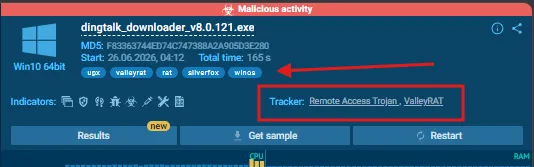
ANY.RUN verdict panel for
dingtalk_downloader_v8.0.121.exe, showing a “Malicious activity” verdict and automatic tagging asvalleyrat,silverfox, andwinos.
Sample Identity (Stage 0 - Dropper)
| Field | Value |
|---|---|
| File name | dingtalk_downloader_v8.0.121.exe |
| MD5 | F83363744ED74C747388A2A905D3E280 |
| SHA256 | BB1CB60FF6EEB6009668354FE7AF609A5495D1AA8998582F8E819DEDCE833930 |
| Format | PE32+, x86-64, 8 sections |
| Packer | SFX |
| Compile timestamp | 2024-02-26 09:01:47 |
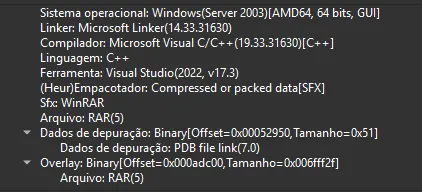
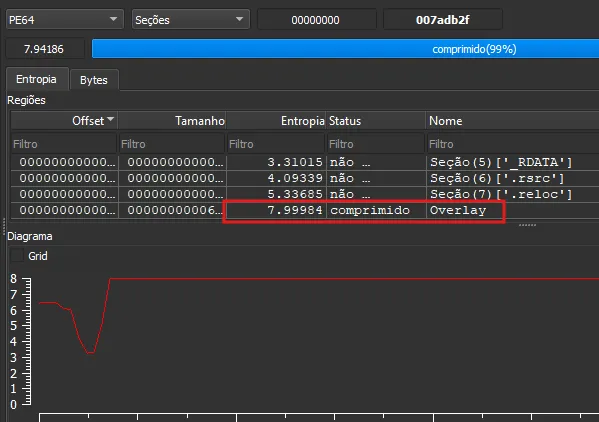
Detect It Easy identifying
dingtalk_downloader_v8.0.121.exeas a PE64 binary packed with SFX.
Infection Chain Overview
dingtalk_downloader_v8.0.121.exe (WinRAR SFX)
  └─ nvsmartmaxapp64.exe          (legitimate, NVIDIA-signed, DLL sideload vector)
        └─ NvSmartMax64.dll        (malicious loader - obfuscated PE, RWX sections)
              └─ reads NvSmartMax64.bin (encrypted blob) → unpacks core module in memory
                    └─ injects into svchost.exe (-k netsvcs)
                          ├─ ValleyRAT core (.text region, no preserved PE header)
                          ├─ statically linked libwebsockets + zlib → C2 transport
                          └─ in-memory config: 206.238.115.209:1234/TCP (redundant slots)
Dynamic Analysis (ANY.RUN)
Process Tree
| PID | Process | Notes |
|---|---|---|
| 8728 | dingtalk_downloader_v8.0.121.exe | WinRAR SFX, writes HKCU\SOFTWARE\WinRAR SFX → c:/uesr |
| 6408 | C:\uesr\dingtalk_downloader.exe | Decoy “DingTalkDownloader Module”, UPX-packed |
| 7512 → 5316 | C:\uesr\nvsmartmaxapp64.exe | Legitimate NVIDIA binary, flagged for untrusted (expired) certificate |
| 6832 | C:\Program Files\Common Files\444.exe | Same NVIDIA version info reused, runs as SYSTEM, “Runs injected code in another process” |
| 1236 | svchost.exe -k netsvcs -p -s Schedule | ”Application launched itself”; creates 3 Scheduled Tasks |
| 7948 | svchost.exe -k netsvcs | YARA hit: VALLEYRAT - final injected process |
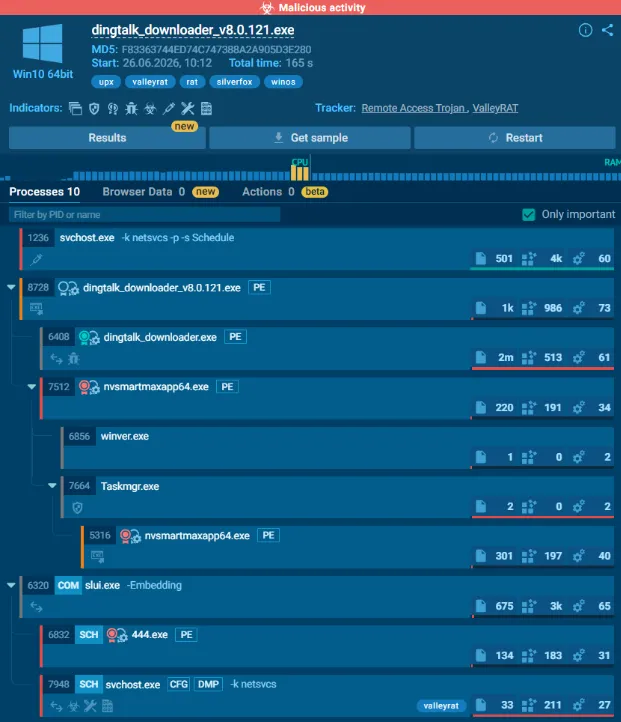
Full process tree in ANY.RUN, from the initial SFX dropper through the NVIDIA-signed carrier to the final injected
svchost.exe(PID 7948) flagged with a VALLEYRAT YARA match.
Persistence Mechanisms
Three Scheduled Tasks are created by svchost.exe (PID 1236) under:
\Microsoft\Windows\UpdateOrchestrator\Schedule Work
\Microsoft\Windows\UpdateOrchestrator\Schedule Wake To Work
\Microsoft\Windows\UpdateOrchestrator\Schedule Maintenance Work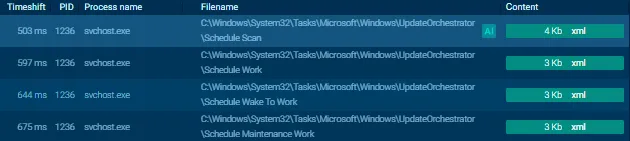
These masquerade as native Windows Update maintenance tasks. Memory forensics also recovered the string
Microsoft Compatibility system, believed to be a forged display name used by the malware at the persistence layer.
Network Indicators
The visible HTTP/DNS traffic in the sandbox is mostly legitimate cover traffic (Microsoft CRL checks, Windows activation, WNS, and genuine DingTalk domains such as dtapp-cast.dingtalk.com and dtupgrade.dingtalk.com). The real C2, 206.238.115.209, was recovered by ANY.RUN’s MalConf module rather than the HTTP/DNS lists, consistent with the WebSocket-based, non-HTTP-monitored transport confirmed later via memory forensics.
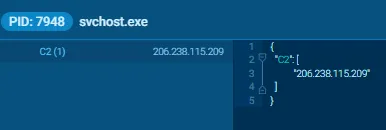
ANY.RUN’s MalConf module automatically extracting the ValleyRAT configuration, including the C2 IP
206.238.115.209.
Static Analysis
Stage 2 - nvsmartmaxapp64.exe (the legitimate carrier)
Static analysis of the memory-dumped nvsmartmaxapp64.exe (identical hash to the dropped 444.exe) confirmed this binary is genuinely signed by NVIDIA and not a forged clone.
| Field | Value |
|---|---|
| MD5 | 41aef580a3eabca0e0c2176c65dcc85b |
| SHA256 | faf8cee3884be9b2fc007df63cc5b9abaa3490eeb1d014e0bcf8a5a78332ad84 |
| Compile timestamp | 2018-03-23 22:26:58 |
| Embedded PDB path | C:\dvs\p4\build\sw\rel\gpu_drv\r390\r391_33\drivers\ui\NvSmartMax\NvSmartMaxApp\bin\release64\NvSmartMaxApp64.pdb |
Authenticode chain:
NVIDIA Corporation → VeriSign Class 3 Code Signing 2010 CA → VeriSign G5 Root
Certificate validity: 2015-07-28 to 2018-07-26
The certificate was valid at compile time but has since expired, which is why ANY.RUN flags the process with “Executing a file with an untrusted certificate” - this is not a forged signature, it is a legitimate but stale one, a hallmark of Silver Fox operators reusing the same old signed LOLBin across campaigns for years.
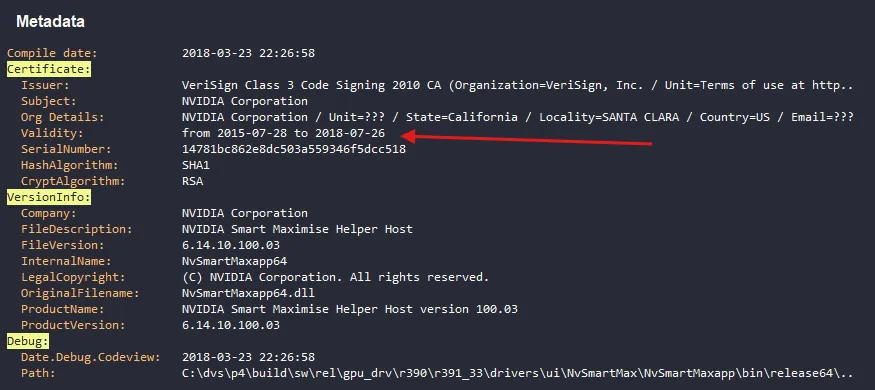
Malcat’s certificate viewer showing
nvsmartmaxapp64.exegenuinely signed by NVIDIA Corporation, with a validity window (2015-07-28 to 2018-07-26) that has since expired.

IAT for
NvSmartMax64.dll, showing the three imported ordinals/names:NvSmartMaxNotifyAppHWND,NVUnHook,NvSmartMaxShutdown. This is the visual evidence for the sideload vector; the exe statically expects a companion DLL with these exact exports.
The import table shows implicit linking against NvSmartMax64.dll for exactly the three functions above. This is the sideload vector: Windows resolves this import by searching the working directory, where the dropper has already placed a malicious NvSmartMax64.dll under the same file name.
Stage 3 - NvSmartMax64.dll (the obfuscated loader)
| Field | Value |
|---|---|
| MD5 | 7638ddd85036b94d9a533a300e7508b2 |
| SHA256 | f535731ad0dd84d1fe7f36638aaa5b285da1caea2ff040b9357cf2aecf3457c1 |
| Size | 5,437,441 bytes |
| TimeDateStamp | 0 (deliberately zeroed) |
Anti-Analysis Techniques Observed
- All 7 section names are zeroed out, and every section shares the same characteristics flag
0xE0000020(READ+WRITE+EXECUTE), defeating heuristics that rely on canonical section names/permissions. - Import DLL name strings are deliberately corrupted:
././KerNEl32,./OLe32,.\./MsVcrt. The Windows loader normalizes and resolves these correctly at runtime, but string-matching static tools may fail to recognize them. - The explicit import table is minimal by design (
VirtualAlloc,LoadLibraryW,GetProcAddress,GetModuleHandleExW, plus MSVCRT file I/O -fopen/fread/fseek/ftell/fclose), meaning the remaining API surface (injection, networking) is resolved dynamically at runtime.

Malcat’s section table for
NvSmartMax64.dll: all 7 section names are zeroed out and every section carries identical RWX characteristics, a deliberate anti-analysis measure.
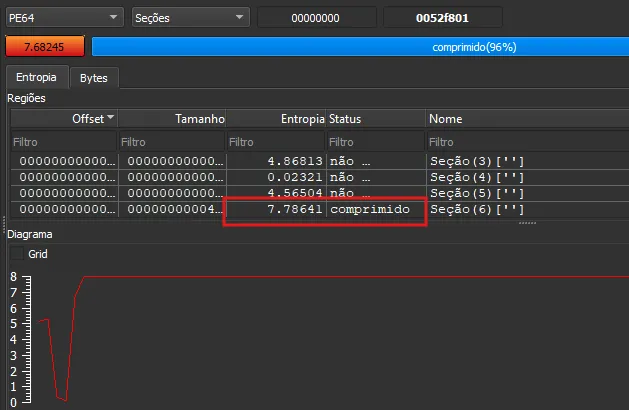
Entropy graph of
NvSmartMax64.dll, showing a flat high-entropy plateau (~7.7–7.8) across the final ~5 MB of the file, consistent with an encrypted/compressed embedded payload.
Export Table - Proxy DLL Pattern
All three exports (NVUnHook, NvSmartMaxNotifyAppHWND, NvSmartMaxShutdown) resolve to the same address (0x180015840), confirming this is a proxy DLL: none of the exports implement real NVIDIA functionality, they all funnel into a single dispatcher stub.
0x180015840: mov [rsp+8], rcx
             sub rsp, 0x68
             lea rax, [rip-0x1420]      ; function pointer #1
             mov [rsp+0x40], rax
             lea rax, [rip+0x4964]      ; function pointer #2
             mov [rsp+0x30], rax
             mov edx, 0x64              ; parameter/ID = 100
             lea rcx, [rsp+0x30]
             call 0x180005cc0           ; dispatcher / callback registration
             call qword ptr [rax]
             ret
RTTI strings recovered from the binary (_Func_impl_no_alloc<lambda_...>) confirm the loader is written in modern C++ using std::function/lambda-based callback dispatch - consistent with the modular, plugin-style architecture documented for Winos4.0/ValleyRAT.
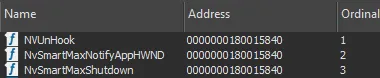
All three exports of
NvSmartMax64.dll(NVUnHook,NvSmartMaxNotifyAppHWND,NvSmartMaxShutdown) resolving to the same address - confirming a proxy-DLL dispatcher pattern rather than genuine NVIDIA functionality.
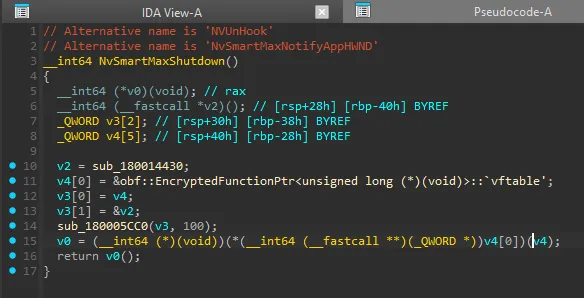
At
DllMain(entry point0x1800168b0), whenfdwReason == DLL_PROCESS_ATTACH, the loader immediately calls an initialization routine (0x180016c80) before handing off to the CRT, meaning malicious logic begins executing the momentnvsmartmaxapp64.exesideloads this DLL.
The Embedded High-Entropy Blob
The final, unnamed section (raw file offset 0x3b600 onward) spans roughly 5.06 MB with entropy 7.786 - effectively random, i.e. encrypted/compressed. Embedded within it are valid PE headers (x86, Rich Header intact) whose recovered import strings reference:
WS2_32.dll,WININET.dll- networking / C2AVIFIL32.dll,MSVFW32.dll- video capture (webcam)WLDAP32.dll- Active Directory enumerationMPR.dll- network resource / share enumeration
This capability set is consistent with the documented feature set of ValleyRAT (webcam access, keystroke/data collection). This blob is the encrypted container for the RAT’s core module(s), decrypted and manually mapped into memory at runtime, the dropped NvSmartMax64.bin is read via the loader’s file I/O imports and is believed to serve as the decryption key/config for this stage.
Deep Dive: XOR Deobfuscation Routine and the Hardcoded Endpoint
Two functions inside the decrypted RAT core (sub_6390 and sub_c520, cross-referenced from sub_6390) were disassembled in Binary Ninja to recover the string obfuscation scheme and confirm the nature of the hardcoded IPv4 address 206.238.115.209 first surfaced by ANY.RUN’s MalConf module.
sub_6390 Environment Gate + String Deobfuscation + Endpoint Dispatch
sub_2d616(arg1, arg2, 0, &var_7f8, 0x208)
0x18000a4e8()
0x18000c89c()
int32_t result = 0x7ffe4782eb10()

if (result == 0)
    ...
    __builtin_memcpy(dest: &var_838, src: "...", count: 0x40)   // encrypted blob, 64 bytes
    int128_t zmm0_1 = var_838.o ^ var_818.o                      // self-XOR against 2nd half of same buffer
    ...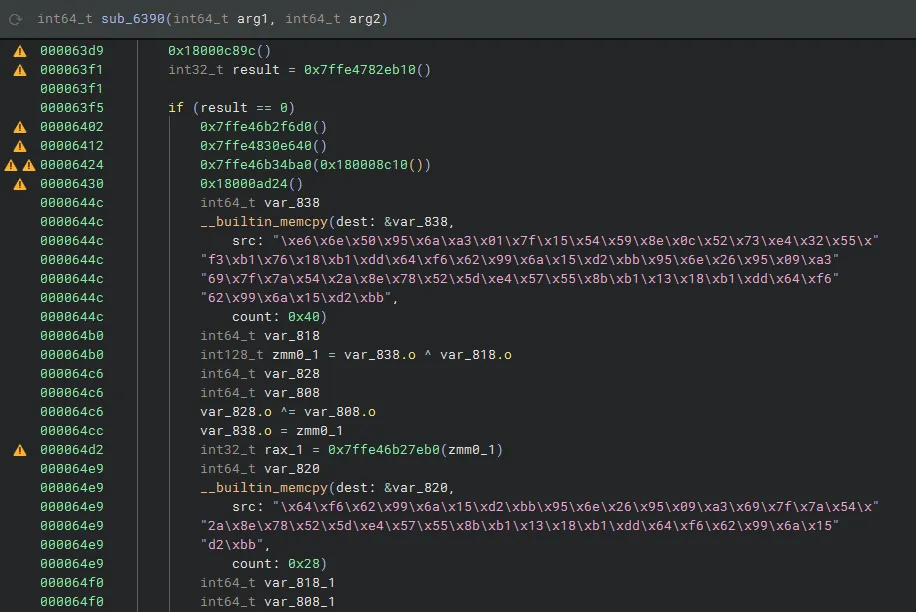
Binary Ninja HLIL view of
sub_6390: an environment/anti-sandbox gate (sub_2d616) followed by unresolved dynamically-resolved API calls (⚠️) and the first XOR-obfuscated string block.
Anti-analysis gate. The function opens with sub_2d616(arg1, arg2, 0, &var_7f8, 0x208), which fills a 0x208-byte stack buffer, followed by several unresolved indirect calls (0x18000a4e8(), 0x18000c89c(), etc. - flagged ⚠️ by Binary Ninja because they are runtime-resolved API pointers, not static imports). The entire string-decoding and C2-dispatch logic that follows is gated behind if (result == 0), consistent with an environment/anti-sandbox check deciding whether to proceed.
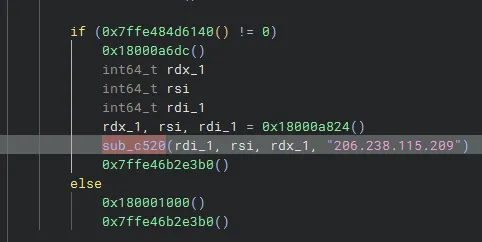
The hardcoded endpoint
206.238.115.209passed directly as a literal argument intosub_c520, alongside three values recovered from the deobfuscation routine above it.
String deobfuscation scheme. Every __builtin_memcpy block in this function copies an obfuscated buffer that is immediately XORed against a second window within the same buffer (e.g., var_838.o ^ var_818.o, where the two “variables” are simply overlapping stack offsets 0x20 bytes apart). In other words: plaintext = blob[0:N/2] XOR blob[N/2:N] - a self-referential split, not an externally-supplied key. This was verified by direct computation rather than pattern inference:
| Block offset | Size | Decoded (UTF-16LE) |
|---|---|---|
0x644c | 64 B | svchost.exe |
0x6507 | 24 B | Schedule |
0x6641 | 24 B | vssvc.exe |
0x66fe/0x6745 | 16 B | "%s\%..." fragment (format string, completed in sub_c520) |
The recovered strings (svchost.exe, Schedule, vssvc.exe) indicate the routine dispatches on the current host process name - one code path when running inside svchost.exe (Task Scheduler-related), a different one for vssvc.exe (Volume Shadow Copy Service), and a fallback path (the one containing the hardcoded IP) for any other host process.
sub_c520 - Task Scheduler Registration Routine
Full disassembly of the callee referenced from the fallback branch above confirmed a coherent Task Scheduler workflow, with every XOR block independently computed and verified against the pseudocode:
| Block offset | Computation | Decoded (UTF-16LE) |
|---|---|---|
0xc5f3 XOR 0xc667 | 64 B ⊕ 64 B | \Microsoft\Windows\AppID |
0xc740 | half ⊕ half (32 B) | "%s\%s" (including literal quotes) |
0xc7bd | half ⊕ half (32 B) | SYSTEM |
0xc7fc, 0xc845 | half ⊕ half (32 B, identical halves) | "" (empty string) |
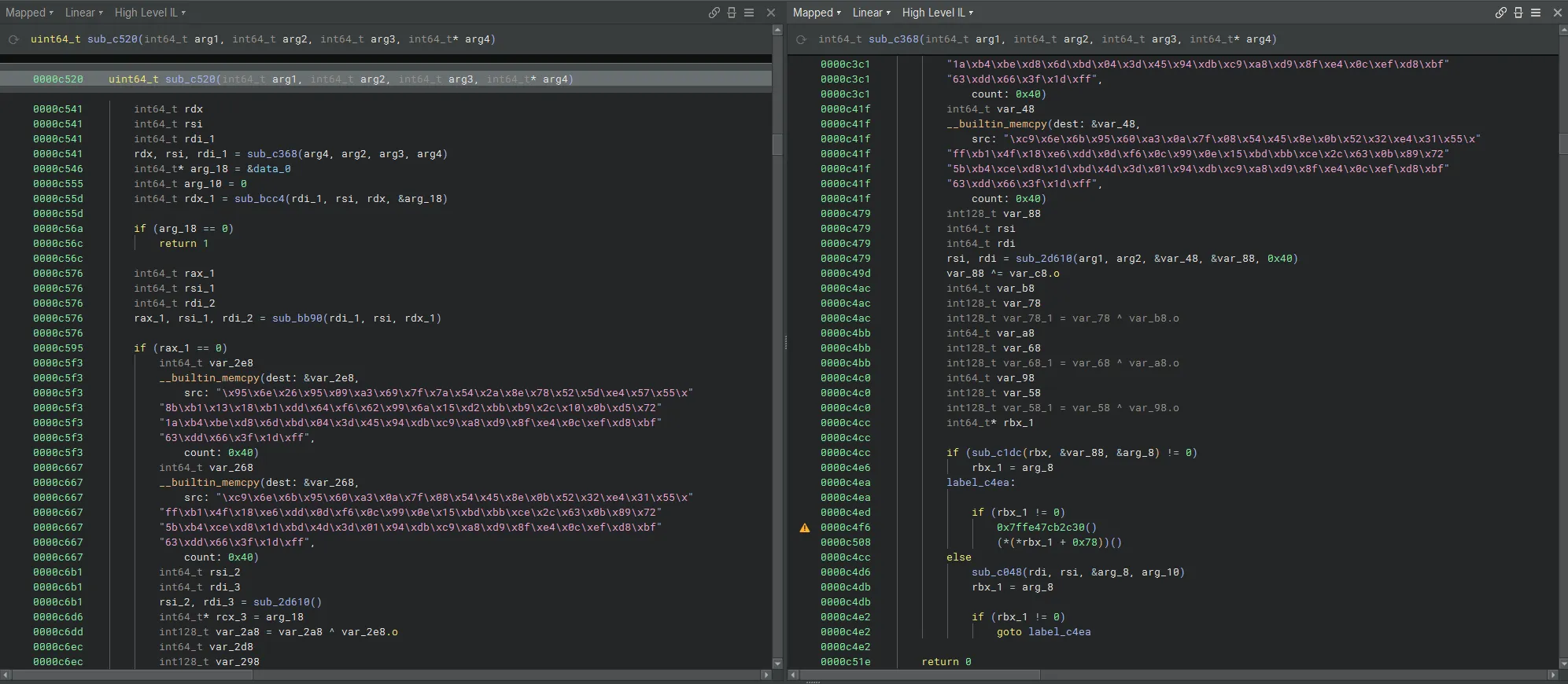
Full HLIL disassembly of
sub_c520, reconstructing a Task Scheduler folder-lookup and task-registration workflow: task folder\Microsoft\Windows\AppID, a quoted command-line format string, principalSYSTEM, and a structured error-code return path.
Reconstructed logic:
uint64_t sub_c520(int64_t arg1, int64_t arg2, int64_t arg3, int64_t* arg4 /* target host */)
{
    // sub_c368 → likely connection/context init; sub_bcc4 → likely ITaskService-equivalent handle
    if (arg_18 == 0) return 1;                     // connection/init failure

    // sub_bb90 → resolves task folder; sub_c1dc → opens folder; sub_c048 → create/recover fallback
    if (arg_10 == 0) return 2;                     // folder open/create failure

    // command line built as: "\"%s\%s\"" (quoted path)
    // principal = "SYSTEM", auxiliary fields = ""

    if (sub_b3d4(rdi_4 + 0x670, rdi_4 + 0x738, r8_3, r9_1) == 0)
        return 4;                                  // task definition build failure

    int32_t rax_7 = sub_b90c(rdi_4, rsi_3, &var_2f8, rdi_4 + 0x670, r8_4);
    return (rax_7 != 0) ? 0 : 3;                    // registration success/failure
}
The final return expression (zx.q(not.d(sbb.d(rax_8, rax_8, rax_7 != 0))) & 3) is Binary Ninja’s literal rendering of a compiled neg/sbb/not flag idiom; it was algebraically reduced and confirmed to be equivalent to rax_7 != 0 ? 0 : 3.
The two 0x100-byte (0xC8 = 200-byte spacing) buffers passed to sub_b3d4 (rdi_4 + 0x670, rdi_4 + 0x738) are consistent with two adjacent wchar_t[100] fields inside a task-context structure - most plausibly a task name and an executable path.
Reassessing the Role of 206.238.115.209
This finding revises the initial dynamic-analysis assumption that 206.238.115.209 is exclusively a WebSocket C2 endpoint:
Evidence for a Task Scheduler / remote-execution role:
sub_c520’s four-argument signature (server, user, domain, password-shaped) and its internal logic (folder lookup under a disguised path, quoted command construction,SYSTEMprincipal, structured task registration) closely match theITaskService::Connect→GetFolder→ITaskDefinition→RegisterTaskDefinitionCOM workflow.- No socket/HTTP/WinInet API references appear anywhere in
sub_c520itself.
Evidence that a separate, genuine C2 channel also exists:
- The in-memory configuration structure recovered from process memory (see below) stores
206.238.115.209alongside an explicit port (1234) and protocol (“TCP”) - a field layout that a COM-basedITaskService::Connectcall has no use for, since Task Scheduler RPC does not take an explicit port in this way. - Separate memory regions from the same injected process contain unambiguous libwebsockets + zlib strings, confirming an active WebSocket-based network channel exists in this binary regardless of this function’s purpose.
Working assessment: the two mechanisms most likely coexist and reuse the same operator-controlled IP - a WebSocket-based C2 channel (confirmed via memory forensics) and, separately, this Task Scheduler-oriented remote-registration capability (confirmed via this static analysis), which may represent either an alternate lateral-movement/execution feature of the same module or a reused library component not necessarily exercised in this specific campaign run. This is not yet fully resolved and is called out explicitly rather than collapsed into a single conclusion - see confidence notes below.
Confidence Summary
| Finding | Confidence | Basis |
|---|---|---|
Strings decoded via self-XOR (svchost.exe, Schedule, vssvc.exe, \Microsoft\Windows\AppID, "%s\%s", SYSTEM) | High | Verified by direct byte-level XOR computation, not pattern inference |
sub_c520 implements a Task Scheduler folder-lookup/registration workflow | High | Structurally coherent argument shapes, decoded strings, and error-code paths all align |
sub_c368/sub_bcc4/sub_bb90 map to specific ITaskService COM methods | Medium | Behavioral/signature inference only - no CLSID/IID observed yet |
206.238.115.209 serves a genuine remote Task Scheduler role | Medium | Strong argument-shape match, but not confirmed via CLSID/IID or PCAP evidence |
206.238.115.209 is also used as a WebSocket C2 endpoint | High | Corroborated independently by the in-memory config structure (port + protocol fields) and libwebsockets/zlib strings recovered from separate memory regions |
Memory Forensics (Post-Injection Dumps)
Four memory regions were dumped from the injected svchost.exe (PID 7948) process for further analysis.
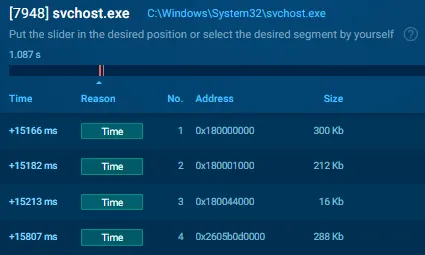
ANY.RUN’s memory dump feature listing the four extracted regions from the injected
svchost.exe(PID 7948) process.
Dump 1 - Decrypted C2 Configuration Structure (16 KB)
Low entropy (2.34 - plaintext/structured, not encrypted). Recovered a repeating 268-byte configuration record:
uint16  port      = 0x04D2 (1234)
wchar_t[]          "TCP"
char[]             "206.238.115.209"
This record repeats three times identically, consistent with ValleyRAT/Winos4.0 reserving multiple redundant C2 server slots even when a campaign only uses one.
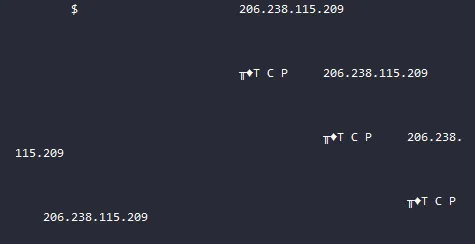
Dump 2 - Raw Executable Code Region (212 KB)
Entropy 6.41, no readable strings - standard x64 function prologue/epilogue byte patterns only (push rbx/rsi/..., pop r15/r14/...). This is the RAT’s .text region as mapped in memory; no PE header was preserved at this location (manual/reflective mapping, consistent with the loader behavior identified in NvSmartMax64.dll).
Dumps 3 & 4 - Statically Linked Network Libraries (307 KB / 294 KB)
ASCII strings recovered:
deflate 1.2.13 Copyright 1995-2022 Jean-loup Gailly and Mark Adler
inflate 1.2.13 Copyright 1995-2022 Mark Adler
%s %s HTTP/1.1
258EAFA5-E914-47DA-95CA-C5AB0DC85B11
LRS_HEADERS: NULL ah
ah leak: wsi %p
bad wsi role 0x%x
The GUID 258EAFA5-E914-47DA-95CA-C5AB0DC85B11 is the fixed magic string used in the RFC 6455 WebSocket handshake, and strings like LRS_HEADERS, wsi, and vhost are unmistakable identifiers of the libwebsockets open-source library. Combined with the zlib 1.2.13 strings, this confirms the RAT’s C2 channel is implemented as a WebSocket connection with compression, not a raw custom TCP protocol as initially hypothesized from the dynamic analysis alone.
UTF-16 strings recovered from the same region:
444.exe
NvSmartMax64.bin
NvSmartMax64.dll
C:\Program Files\Common Files
Microsoft Compatibility system
\Microsoft\Windows
"Microsoft Compatibility system" is assessed to be a forged display name used at the persistence layer.
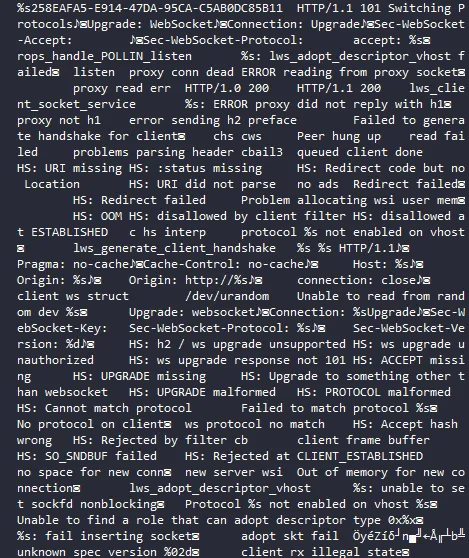
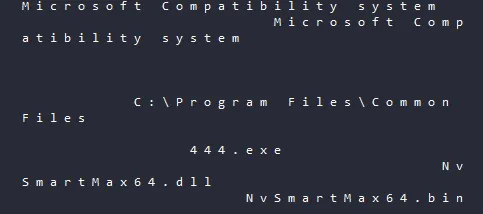
This cleanly demonstrates the embedded libwebsockets/zlib fingerprint
MITRE ATT&CK Mapping
| Tactic | Technique | ID |
|---|---|---|
| Initial Access | Trojanized software / Masquerading as legitimate installer | T1204.002 |
| Defense Evasion | Masquerading (fake NVIDIA vendor helper) | T1036.005 |
| Defense Evasion | DLL Side-Loading | T1574.002 |
| Defense Evasion | Obfuscated Files or Information (section/import name corruption) | T1027 |
| Defense Evasion | Process Injection | T1055 |
| Defense Evasion | Signed Binary Proxy Execution | T1218 |
| Persistence | Scheduled Task | T1053.005 |
| Command and Control | Application Layer Protocol: Web Protocols (WebSocket) | T1071.001 |
| Command and Control | Data Encoding / Compression | T1132 / T1560 |
Indicators of Compromise (IOCs)
Files
| Stage | File | SHA256 |
|---|---|---|
| Dropper | dingtalk_downloader_v8.0.121.exe | BB1CB60FF6EEB6009668354FE7AF609A5495D1AA8998582F8E819DEDCE833930 |
| Decoy | dingtalk_downloader.exe | 91E6278F9B1756BAF0FE3A4F7F6A1897ED1C1811DE51AE3934E0360327EEB9EA |
| Carrier (signed) | nvsmartmaxapp64.exe / 444.exe | FAF8CEE3884BE9B2FC007DF63CC5B9ABAA3490EEB1D014E0BCF8A5A78332AD84 |
| Encrypted blob | NvSmartMax64.bin | 5285FEA2296D848992025565DBAB08CD45CAC7AE62102428EE60FCA47E7F00D5 |
| Malicious loader | NvSmartMax64.dll | F535731AD0DD84D1FE7F36638AAA5B285DA1CAEA2FF040B9357CF2AECF3457C1 |
Network
- C2:
206.238.115.209:1234/TCP(WebSocket protocol)
Filesystem / Persistence
C:\uesr\dingtalk_downloader.exe
C:\uesr\nvsmartmaxapp64.exe
C:\uesr\NvSmartMax64.bin
C:\uesr\NvSmartMax64.dll
C:\Program Files\Common Files\444.exe
C:\Program Files\Common Files\NvSmartMax64.bin

\Microsoft\Windows\UpdateOrchestrator\Schedule Work
\Microsoft\Windows\UpdateOrchestrator\Schedule Wake To Work
\Microsoft\Windows\UpdateOrchestrator\Schedule Maintenance Work
Strings / Artifacts
Microsoft Compatibility system
258EAFA5-E914-47DA-95CA-C5AB0DC85B11 (generic WebSocket GUID - context-dependent)
Detection Recommendations
- Alert on
svchost.exechild processes or memory regions exhibiting statically-linked libwebsockets + zlib signatures combined with co-occurring references toNvSmartMax64.bin/NvSmartMax64.dll- do not alert on the library strings alone, as they are common in legitimate software. - Flag execution of vendor-named binaries (NVIDIA, or otherwise) launched from non-standard install paths (e.g.,
C:\uesr\, arbitrary subfolders ofCommon Files) with expired code-signing certificates. - Monitor creation of Scheduled Tasks under
\Microsoft\Windows\UpdateOrchestrator\with action paths pointing outsideC:\Windows\System32. - Hunt for PE sections with all-zeroed names combined with uniform
RWXcharacteristics across every section - a strong packing/obfuscation indicator uncommon in legitimate compilers.
Detection Engineering
To support hunting for anti-sandbox behavior across future ValleyRAT/Winos4.0 samples and their intermediate dumps, the Sigma rule “Reads the date of Windows installation” (ID 127761ea-d787-4a52-aefe-dde82dbf45c8, T1012/T1082/T1497.003) was translated into a static YARA equivalent.
This is not a 1:1 port: Sigma’s registry/sandbox logsource describes a runtime telemetry event (an EDR/sandbox observing a process read a specific registry value), while YARA inspects static bytes in a file or memory image. There is no direct static equivalent for “a process read this key” - what is portable is the underlying intent: detecting whether a binary carries the logic to perform this classic anti-sandbox/anti-VM timing check (T1497.003), which is exactly the kind of artifact expected inside a loader stage like NvSmartMax64.dll or an unpacked RAT core module such as the ones recovered from memory in this case.
The Sigma rule’s correction1/2/3 filters (which suppress known-legitimate callers by Image path - Search Host, Windows Terminal) also have no static equivalent, since process identity/path is execution context, not something present in an isolated file. To compensate, the YARA rule below requires the registry key path, the value name, and a registry API call to all be present together, rather than firing on any single string in isolation - reducing the surface for accidental matches against unrelated strings.
Two variants are provided: one constrained to PE files (for scanning samples/dropped binaries), and one unconstrained (for scanning raw, headerless memory dumps like the ones extracted from the injected svchost.exe in this investigation).
rule Anti_Sandbox_InstallDate_Registry_Check_File
{
    meta:
        description     = "Detects PE binaries with static references to the Windows InstallDate registry value + registry query APIs, consistent with an anti-sandbox/anti-VM environment check"
        sigma_reference = "127761ea-d787-4a52-aefe-dde82dbf45c8"
        sigma_title     = "Reads the date of Windows installation"
        author          = "0xOlympus"
        date            = "2026-07-04"
        mitre_attack    = "T1012, T1082, T1497.003"
        scope           = "file"
        level           = "medium"

    strings:
        // Registry key path (32-bit and 64-bit views, ASCII + wide)
        $key_a1 = "SOFTWARE\\Microsoft\\Windows NT\\CurrentVersion" ascii nocase
        $key_w1 = "SOFTWARE\\Microsoft\\Windows NT\\CurrentVersion" wide nocase
        $key_a2 = "SOFTWARE\\Wow6432Node\\Microsoft\\Windows NT\\CurrentVersion" ascii nocase
        $key_w2 = "SOFTWARE\\Wow6432Node\\Microsoft\\Windows NT\\CurrentVersion" wide nocase

        // Target value name
        $val_a = "InstallDate" ascii nocase
        $val_w = "InstallDate" wide nocase

        // Registry read APIs commonly used to pull this value
        $api1 = "RegQueryValueExA"
        $api2 = "RegQueryValueExW"
        $api3 = "RegOpenKeyExA"
        $api4 = "RegOpenKeyExW"
        $api5 = "RegGetValueA"
        $api6 = "RegGetValueW"

    condition:
        uint16(0) == 0x5A4D
        and any of ($key_*)
        and any of ($val_*)
        and any of ($api*)
}

rule Anti_Sandbox_InstallDate_Registry_Check_Memory
{
    meta:
        description     = "Memory/dump-scan variant: detects raw or headerless memory regions referencing the InstallDate registry value alongside registry query APIs (no MZ/PE constraint, for unpacked/manually-mapped modules)"
        sigma_reference = "127761ea-d787-4a52-aefe-dde82dbf45c8"
        sigma_title     = "Reads the date of Windows installation"
        author          = "0xOlympus"
        date            = "2026-07-04"
        mitre_attack    = "T1012, T1082, T1497.003"
        scope           = "memory"
        level           = "medium"

    strings:
        $key_a1 = "SOFTWARE\\Microsoft\\Windows NT\\CurrentVersion" ascii nocase
        $key_w1 = "SOFTWARE\\Microsoft\\Windows NT\\CurrentVersion" wide nocase
        $key_a2 = "SOFTWARE\\Wow6432Node\\Microsoft\\Windows NT\\CurrentVersion" ascii nocase
        $key_w2 = "SOFTWARE\\Wow6432Node\\Microsoft\\Windows NT\\CurrentVersion" wide nocase

        $val_a = "InstallDate" ascii nocase
        $val_w = "InstallDate" wide nocase

        $api1 = "RegQueryValueExA"
        $api2 = "RegQueryValueExW"
        $api3 = "RegOpenKeyExA"
        $api4 = "RegOpenKeyExW"
        $api5 = "RegGetValueA"
        $api6 = "RegGetValueW"

    condition:
        any of ($key_*)
        and any of ($val_*)
        and any of ($api*)
}
Tuning Notes
- File variant anchors on
uint16(0) == 0x5A4D(MZ) to scope the rule to PE files only - use this against the dropper, the carrier.exe, and theNvSmartMax64.dllloader. - Memory variant drops the header check entirely, since reflectively-mapped/injected modules (such as the
.textregion recovered from PID 7948 in this case) do not preserve a DOS/PE header at their dump base. - Both variants trade recall for precision by requiring key path + value name + API to co-occur, rather than matching on
InstallDatealone - the bare string is common enough in legitimate telemetry/licensing code to be noisy on its own. - As with the Sigma source rule, treat a hit as a triage signal, not a standalone verdict - legitimate browsers, Office, Adobe products, and archivers perform this same check for entirely benign reasons (installation-age telemetry, licensing).
- Applied to this investigation’s artifacts specifically: this rule did not fire on the dumps recovered so far (
NvSmartMax64.dll’s explicit imports do not include the registry API family, and the decrypted C2 config dump contains no registry-related strings) - worth re-running once the encrypted ~5 MB blob insideNvSmartMax64.dllis decrypted and mapped, since that is the most likely location for any anti-sandbox timing logic in this chain.
Conclusion
This sample demonstrates a mature, multi-stage ValleyRAT deployment chain that leans heavily on living-off-trusted-binaries tradecraft: rather than forging a vendor identity, the operators repurpose a genuinely signed (if now-expired) NVIDIA utility to bootstrap a DLL sideload, hide their loader behind deliberate PE structural corruption, and finally establish C2 over a standard, encrypted-looking WebSocket channel to blend in with legitimate web traffic. The combination of dynamic detonation, static reverse engineering, and post-injection memory forensics was necessary to fully reconstruct the chain - no single vantage point exposed the complete picture on its own.